


EnergyLIB Australia | Blog Page Content | July 2026
Solar Sharer Offer Australia // BLOG PAGE Content // EnergyLIB
Solar Sharer Offer Australia: How 3 Hours of Free Electricity Creates a Battery Opportunity for Installers and Dealers
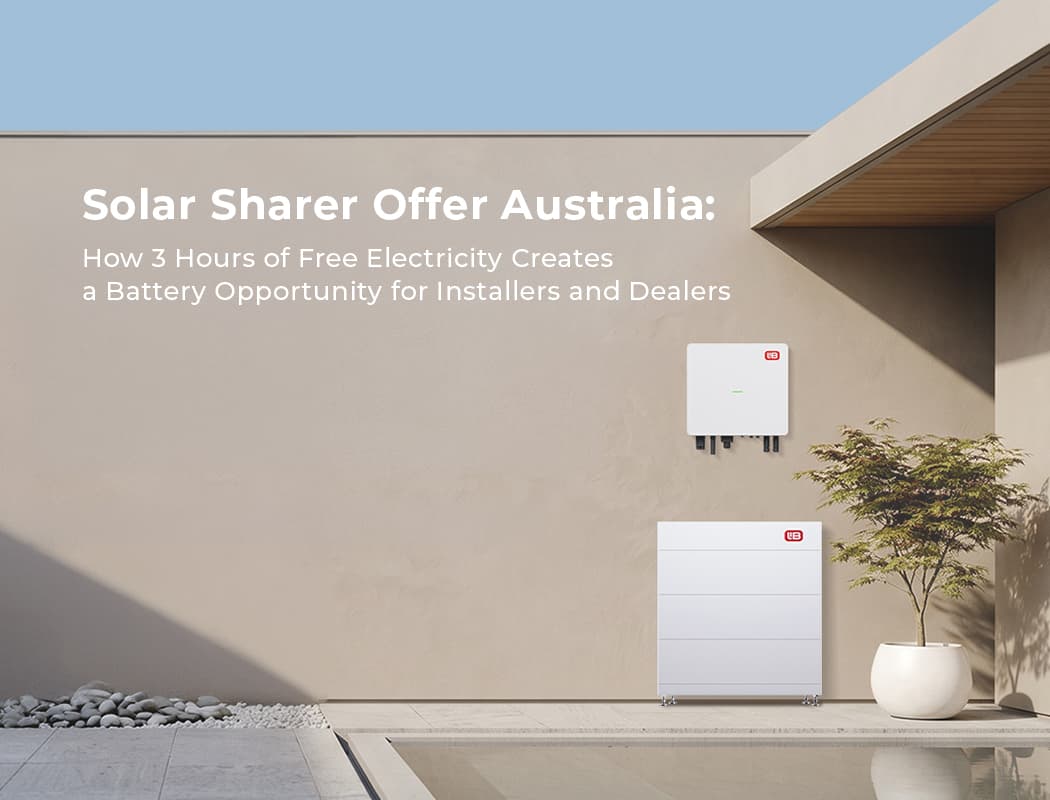
The Solar Sharer Offer gives eligible households access to 3 hours of free electricity in the middle of every day. The idea is simple: when solar generation is abundant during the day, households can shift energy use into that free-power window instead of relying as heavily on evening grid electricity. For homeowners, this creates a new reason to think about how and when they use power. For installers and dealers, it creates a new reason to talk about solar batteries.
Without a battery, the offer mainly helps households that can run appliances during the free window. With a battery, the conversation becomes more powerful. A home battery can be positioned as a way to store low-cost or free midday energy, then use that stored power later when the home actually needs it.
This article explains how the 3 hours of free electricity works, why it matters for home battery sales and how EnergyLIB partners can use LIB HomeStack as a modular solar battery solution for Australian homes.
Quick Answer: What Is the Solar Sharer Offer?
| Quick Answer |
|---|
| The Solar Sharer Offer is a regulated electricity offer that gives eligible households in New South Wales, South Australia and South East Queensland access to 3 hours of free electricity in the middle of every day. It is optional, requires a smart meter, and provides up to 24 kWh of free electricity during the daily free-power period. For battery owners, the opportunity is to charge a home battery during the free window and use stored energy later in the evening, where the system and electricity plan allow it. |
How the 3 Hours of Free Electricity Works
The Solar Sharer Offer is designed to share the benefit of abundant midday solar generation with more households, including households that do not own rooftop solar. It is available in Default Market Offer areas: New South Wales, South Australia and South East Queensland.
Under the offer, eligible households can access a daily free-power period. In New South Wales and South East Queensland, the free-power window runs from 11am to 2pm. In South Australia, it runs from 12pm to 3pm. The offer provides up to 24 kWh of free electricity during the 3-hour window each day.
It is important to explain this clearly to homeowners: the Solar Sharer Offer does not mean the whole electricity bill becomes free. Customers still pay for electricity used outside the 3-hour window, and they still pay the daily supply charge. The Australian Energy Regulator determines the main tariff settings, including usage rates outside the free-power window and any charge that may apply if the household uses more than 24 kWh during the free period.
Why the Solar Sharer Offer Matters for Solar Battery Suppliers
The Solar Sharer Offer changes the way homeowners think about electricity. Instead of seeing power as one flat daily cost, they start to understand that timing matters. Power used in the free window can be worth more than power used later in the day. This is exactly the type of education that supports solar battery adoption.
For a solar battery supplier, the opportunity is to connect the policy to a practical product solution. The homeowner may understand that free electricity is available from 11am to 2pm, but they may not be home during that time. They may not want to run every appliance at midday. They may have evening air-conditioning demand, cooking loads, entertainment use, lighting, or EV charging needs. A home battery becomes the bridge between the free-power window and the household's real energy routine.
The Battery Opportunity: Store Free Midday Power, Use It Later
Use the free-power window to charge the battery, then use stored energy later when electricity is no longer free. This does not mean every household will save automatically. The actual benefit depends on the customer's retailer plan, system settings, battery capacity, household usage pattern and rates outside the free period.
Without a battery, the customer must shift appliances into the free window. With a battery, the customer can shift energy value into the evening. That is the key difference.
How Different Household Types Can Benefit
| Household Type | Without Battery | With Battery |
|---|---|---|
| Working household | May miss the free window because nobody is home. | Can charge the battery during the free period where settings allow. |
| Family home | Can run some appliances during the free window. | Can support larger evening loads after school and work. |
| High-usage home | May use more than the free-window cap. | Can pair load shifting with larger battery capacity. |
| EV-ready home | Can charge some devices or EV during free hours. | Can combine battery strategy with household load management. |
| Solar-only home | Can self-consume more during the day. | Can store excess solar and free-window energy for later. |
How EnergyLIB Fits the 3 Hours Free Electricity Conversation
For customers who want to take advantage of the Solar Sharer Offer, LIB HomeStack can be positioned around three key ideas: store more free or low-cost midday power, reduce evening grid reliance and choose the right storage size for the home.
The product features also support strong positioning. LIB HomeStack offers flexible modular capacities in 16 kWh, 32 kWh and 48 kWh options. It uses LFP chemistry, supports 100% Depth of Discharge, is designed as a low-voltage residential battery system, has IP65 weatherproof resilience, and is built with a home-first product design. EnergyLIB also provides the benefits for dealers: protected margins, selective partner development, competitive wholesale rates and Australian-based support.
| EnergyLIB Advantage | What It Means | How Dealers Can Use It |
|---|---|---|
| Protected margins | Selective partner network and protected pricing. | Promote EnergyLIB without competing against a saturated dealer network. |
| Local support | Australian-based technical and after-sales support. | Give customers confidence that real support is available. |
| Silent power | Fanless inverter operation under 45 dB. | Position as home-friendly and quiet. |
| Safety and lifespan | 8,000 cycles, 100% DoD and built-in aerosol fire protection. | Support premium, safety-led product conversations. |
| Weatherproof resilience | IP65 rated enclosure for suitable outdoor conditions. | Useful for Australian climate and practical home installations. |
| Flexible capacities | 16 kWh, 32 kWh and 48 kWh modular stack options. | Create simple packages for different home types. |
FAQs
What is the Solar Sharer Offer?
The Solar Sharer Offer is a regulated energy offer that gives eligible households in NSW, South Australia and South East Queensland access to 3 hours of free electricity in the middle of each day.
Do households need rooftop solar to access the offer?
No. Eligible households do not need rooftop solar to opt in, but they need a smart meter and must be with a retailer required to offer the plan.
Is the whole electricity bill free?
No. The free electricity only applies during the daily 3-hour window, up to the eligible cap. Supply charges and electricity used outside the free period still apply.
Can a solar battery store the free electricity?
Yes, where the electricity plan, battery system and settings allow it. Customers should confirm details with their retailer and installer before relying on this strategy.
Why does this matter for solar installers?
It gives installers a strong reason to talk about battery storage, load shifting, smart meter readiness and modular home energy systems with customers.
Which EnergyLIB battery size fits this opportunity?
EnergyLIB partners can position 16 kWh for many standard homes, 32 kWh for larger households and 48 kWh for high-usage homes that want more storage headroom.
Why should businesses partner with EnergyLIB?
EnergyLIB offers protected margins, competitive wholesale rates, local Australian support, strong brand credibility and premium product advantages including LFP chemistry, IP65 protection and modular 16–48 kWh capacity.