


What Size Solar Battery Do I Need? An Essential Sizing Guide for Australian Homes
A family of four in the western suburbs of Melbourne installed a 6.6kW solar panel system last year. Their electricity bill dropped, but not by as much as they hoped. During daylight hours, their panels were generating more electricity than the household could use.
That excess solar energy was being fed back into the grid for a few cents per kilowatt-hour. Then every evening, once the cooking started and the ducted heating kicked in, they were buying that same energy back at three or four times the price.
They knew battery storage was the answer. But the first question that stopped them was not which brand or which chemistry. It was simpler than that: what size solar battery do I actually need?
Get it wrong and you either run out of stored energy before morning or pay for capacity you never touch. Get it right and you dramatically increase your solar self consumption, cut your electricity costs, and build genuine energy independence.
At EnergyLIB, we are Australia's first home energy brand designed exclusively for the home. The LIB HomeStack is available in three configurations, 16.08 kWh, 32.15 kWh, and 48.23 kWh, each with 100% depth of discharge, meaning every kilowatt-hour is usable capacity. This guide explains how to determine which size is right for your household.
Step 1: Understand Your Daily Energy Consumption
The starting point for choosing the right solar battery size is knowing how much energy your household actually uses, and when you use it.
Your electricity bill will show your daily energy consumption in kilowatt hours (kWh). Most Australian homes use between 15 and 25 kWh per day, but this varies depending on:
- Household size and number of occupants
- Air conditioning and hot water systems (electric vs. gas vs. heat pump)
- Electric vehicle charging
- Pool pumps, home offices, and other high-draw appliances
- Usage patterns across daytime, evening, and overnight periods
The critical number for battery sizing is not your total daily usage. It is how much electricity you consume when your solar panels are not producing.
That means evenings, overnight, and overcast mornings. For most Australian households, this is between 8 and 15 kWh per day, though larger homes and homes with electric vehicles can exceed 20 kWh comfortably.
Step 2: Look at Your Solar System Size
Your solar system size directly affects how much excess energy is available to charge a battery. If your solar panel system is not producing enough surplus after covering daytime use, a battery will struggle to fully charge each day.
- A 5kW solar system typically produces 18 to 22 kWh per day.
- A 6.6kW system produces 22 to 28 kWh per day.
- Larger solar systems of 10kW or more can comfortably fill a 32 kWh or 48 kWh battery.
A larger solar panel system can generate more electricity, which may require a larger battery to store the excess energy. Larger or more efficient panels can produce more power, enhancing overall system performance and storage capacity.
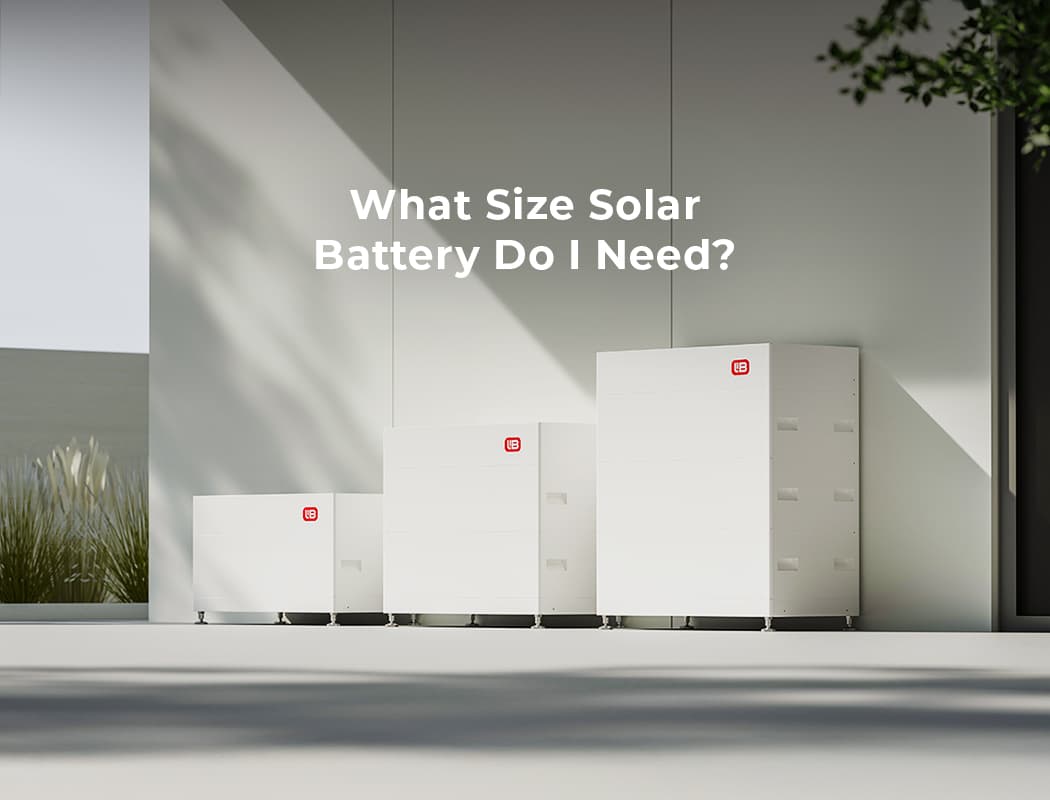
If your solar generation only just covers your daytime consumption, a 16 kWh battery like the LIB HomeStack I is likely the right starting point. If you have a larger system with significant surplus energy, the LIB HomeStack II or III will capture and store more of that excess solar energy for evening and overnight use.
Step 3: Understand Usable Battery Capacity
This is where many homeowners get caught out. The battery capacity advertised on many products is not always the amount of stored energy you can actually use.
The difference comes down to depth of discharge (DoD): To calculate usable capacity, only factor in the amount you can actually use without damaging the cells, which is typically lower than total capacity.
- A 13.5 kWh battery with 90% DoD gives you approximately 12.15 kWh of usable capacity.
- A 16.08 kWh battery with 100% DoD gives you a full 16.08 kWh of usable battery capacity.
Lithium ion batteries are commonly used in solar energy storage due to their high capacity and efficiency, and typically have a specific DoD rating.
The LIB HomeStack is engineered for 100% depth of discharge across all three models. That means the usable capacity matches the total capacity. The number on the spec sheet is the number you get. No hidden buffers, no locked-out capacity.
| Specification | LIB HomeStack I | LIB HomeStack II | LIB HomeStack III |
|---|---|---|---|
| Total / Usable Capacity | 16.08 kWh | 32.15 kWh | 48.23 kWh |
| Depth of Discharge | 100% | 100% | 100% |
| Rated DC Power | 8 kW | 12 kW | 12 kW |
| Cycle Life | 8,000+ | 8,000+ | 8,000+ |
| Battery Chemistry | LFP | LFP | LFP |
| Ingress Rating | IP65 | IP65 | IP65 |
| Dimensions (W×H×D mm) | 850×458×440 | 850×701×440 | 850×944×440 |
| Weight | 136 kg | 251 kg | 366 kg |
| Warranty | 10 years | 10 years | 10 years |
Which LIB HomeStack Size Is Right for Your Home?
LIB HomeStack I: 16.08 kWh
The LIB HomeStack I is the entry point to the range, and for most Australian households, it is more than enough power to dramatically shift how you use solar energy.
This size is well suited to:
- Households of 2 to 4 people with average daily energy consumption of 15 to 25 kWh.
- Homes with a 5kW to 8kW solar panel system.
- Homeowners focused on maximising solar self consumption and reducing electricity bills.
- Backup power for essential appliances during power outages.
With 16.08 kWh of fully usable capacity, the LIB HomeStack I comfortably covers evening and overnight energy usage for most standard homes, which typically falls between 8 and 14 kWh. That leaves headroom for cloudy days and higher-than-average usage periods.
At 8kW rated DC power, it delivers enough continuous power for typical household loads including lighting, fridge, cooking, entertainment, and moderate heating or air conditioning.
LIB HomeStack II: 32.15 kWh
The LIB HomeStack II doubles the capacity for homes that need more.
This size suits:
- Larger households of 4 to 6 people with higher electricity use.
- Homes running electric hot water systems, ducted air conditioning, or a home office with heavy equipment.
- Electric vehicle owners who charge at home overnight.
- Homeowners who want extended backup power during outages, covering more than just essential appliances.
- Properties with larger solar systems of 8kW to 13kW that produce significant excess energy.
With 32.15 kWh of usable energy and 12kW of rated DC power output, the LIB HomeStack II can sustain high-draw appliances and multiple simultaneous loads. It is ideal for households that want to move toward genuine energy independence without going fully off grid.
LIB HomeStack III: 48.23 kWh
The LIB HomeStack III is the full capacity configuration, designed for households that demand the most from their battery system.
This size is ideal for:
- Large properties with 5 or more occupants and daily energy consumption above 30 kWh.
- Homes paired with larger solar systems of 10kW to 15kW or more.
- Off grid or near-off grid households aiming for maximum energy independence.
- Properties with electric vehicles, pool heating, hot water systems, and multiple air conditioner units.
- Whole-home blackout protection, keeping everything running during extended power outages.
At 48.23 kWh of usable capacity, the LIB HomeStack III stores enough energy to power most large Australian homes through an entire evening, night, and morning before solar generation kicks back in. For homes with sufficient solar panels, it can achieve near-complete self consumption of solar energy, drastically reducing reliance on grid electricity and feed in tariffs.
Why the LIB HomeStack's Stackable Design Matters for Sizing
One of the biggest risks with battery installation is getting the size wrong at the point of purchase. The LIB HomeStack addresses this with a stackable connection design. Many solar batteries today are designed as modular systems, allowing users to add more capacity as their needs grow.
- Each battery module stacks on top of the previous one. No complex wiring. No additional enclosures.
- A self-levelling base provides stable placement across uneven ground and varied installation conditions.
- The IP65-rated waterproof and dustproof enclosure makes it suitable for both indoor and outdoor use.
- The minimal design is made to blend into your home, not stand out. It belongs around the living space, not hidden in a shed.
Modern solar batteries are modular and expandable, enabling users to increase storage capacity over time by adding more units. Stackable battery systems allow for incremental increases in capacity, so you can start with a smaller setup and add more capacity later as your energy needs change.
Many modern battery systems allow for future expansion, so you don't have to commit to a large system upfront. Modular solar battery systems can help users avoid the costs associated with completely replacing their battery systems when energy needs change.
This means if you start with the LIB HomeStack I today and your energy needs grow, whether through an electric vehicle, a growing family, or future energy demands, your system can expand without replacing the existing setup.
| Key Technical Specifications: LIB HomeStack Range | |
|---|---|
| Battery type | LiFePO4 (LFP) |
| Depth of discharge | 100% |
| Cycle life | 8,000+ cycles at 25°C, 70% end-of-life capacity |
| Nominal voltage | 51.2V (48V low-voltage system) |
| Ingress rating | IP65, waterproof and dustproof, suitable for outdoor use |
| Safety | Circuit breaker per battery pack, automatic fire extinguishing, pressure relief |
| Cooling | Natural convection (no fans, no noise) |
| Warranty | 10 years |
| Certifications | IEC 61000, IEC 62619, IEC 62040-1, UN38.3 |
CEC Approved: Why It Matters When Choosing a Solar Battery
In Australia, the Clean Energy Council (CEC) maintains an approved battery list of products that meet strict safety and performance standards. CEC approval is not optional. It is a requirement for:
- Accessing the federal battery rebate under the Cheaper Home Batteries Program.
- Claiming Small-scale Technology Certificates (STCs) that reduce your upfront cost.
- Connecting your battery system to the grid through your local electricity distributor.
- Eligibility for state-level rebate programs in Victoria, New South Wales, Queensland, and Western Australia.
- Participation in Virtual Power Plant (VPP) programs.
If a battery is not on the CEC approved list, you cannot claim government incentives, and your electricity distributor may refuse to connect it. This means thousands of dollars in rebates could be left on the table, and your system may not be legally connected.
All three LIB HomeStack configurations, the 16.08 kWh, 32.15 kWh, and 48.23 kWh, are listed on the Clean Energy Council approved battery list. They were approved on 3 February 2026 and meet the requirements of international safety standards including IEC 62619, IEC 62040-1, and UN38.3.
When comparing battery options, always verify that the specific model you are considering is on the current CEC approved list. Brand recognition alone is not enough. The approval is model-specific, and products can be added or removed as standards evolve.
| CEC Approval Checklist: LIB HomeStack | |
|---|---|
| LIB BSS01L16 I (16.08 kWh) | CEC approved, 3 February 2026 |
| LIB BSS01L16 II (32.15 kWh) | CEC approved, 3 February 2026 |
| LIB BSS01L16 III (48.23 kWh) | CEC approved, 3 February 2026 |
| Eligible for | Federal battery rebate, STCs, state rebates, VPP programs, grid connection |
| Certifications | IEC 61000, IEC 62619, IEC 62040-1, UN38.3 |
Other Factors That Affect Your Battery Size Decision
Feed-in Tariffs and Bill Savings
With feed in tariffs declining across most Australian states, the financial case for storing your own solar power gets stronger every year. A battery sized to capture most of your excess energy will deliver greater bill savings than a smaller battery that still allows significant grid export at low rates.
Peak Demand and Time-of-Use Tariffs
If your electricity costs spike during peak demand periods (typically 3pm to 9pm), a battery that covers your peak usage delivers outsized savings. The LIB HomeStack II and III, with their 12kW rated DC power output, are built to handle simultaneous high-draw loads during peak windows.
Future Energy Needs
Planning to add an electric vehicle, switch from gas to electric hot water, or expand your home? Future energy consumption will likely increase. Choosing a modular system now means you are not locked into today's requirements. The LIB HomeStack grows with your household.
| Battery Sizing Checklist | |
|---|---|
| 1. Check your electricity bill. | Find your average daily energy consumption in kWh. |
| 2. Estimate evening and overnight usage. | Typically 50% to 70% of total daily usage. This is the energy your battery needs to cover. |
| 3. Check your solar generation surplus. | How much excess solar energy does your system produce after daytime use? |
| 4. Match to a LIB HomeStack configuration. | 16 kWh for standard homes, 32 kWh for high usage or EV charging, 48 kWh for off grid or maximum independence. |
| 5. Factor in backup power needs. | Essential appliances only, or whole-home coverage during outages? |
| 6. Think ahead. | Electric vehicle, growing family, or home expansion planned? Choose a system that can scale. |
FAQs
What size solar battery do I need for a 6.6kW solar system?
A 6.6kW solar panel system typically produces 22 to 28 kWh per day. After covering daytime usage, most households have 10 to 15 kWh of surplus. The LIB HomeStack I at 16.08 kWh is an excellent match, capturing most or all of that excess energy with usable capacity to spare. Homes with higher consumption or an electric vehicle may benefit from the LIB HomeStack II at 32.15 kWh.
Is 16 kWh enough battery for an average Australian home?
Yes. Most Australian households use between 8 and 14 kWh during evening and overnight hours when solar panels are not producing. The LIB HomeStack I provides 16.08 kWh of fully usable capacity at 100% depth of discharge, which comfortably covers this range with headroom for higher usage days and backup power for essential appliances.
Can I expand my LIB HomeStack later?
Yes. The LIB HomeStack uses a stackable, plug-and-play design. You can start with the LIB HomeStack I and add modules to reach the LIB HomeStack II (32.15 kWh) or LIB HomeStack III (48.23 kWh) configuration as your energy needs grow, without replacing the existing system.
Is the LIB HomeStack on the CEC approved battery list?
Yes. All three LIB HomeStack models (16.08 kWh, 32.15 kWh, and 48.23 kWh) are listed on the Clean Energy Council approved battery list as of 3 February 2026. This means they are eligible for the federal battery rebate, Small-scale Technology Certificates (STCs), state-level incentive programs, grid connection, and Virtual Power Plant participation. Always check that any battery you consider is on the current CEC approved list before purchasing.
What is the difference between battery capacity and usable capacity?
Battery capacity is the total energy a battery can theoretically store. Usable capacity is the amount you can actually draw on, determined by depth of discharge (DoD). Many batteries hold back 5 to 20% as a buffer. The LIB HomeStack operates at 100% DoD, meaning every kilowatt-hour of its 16.08, 32.15, or 48.23 kWh capacity is available as usable energy.